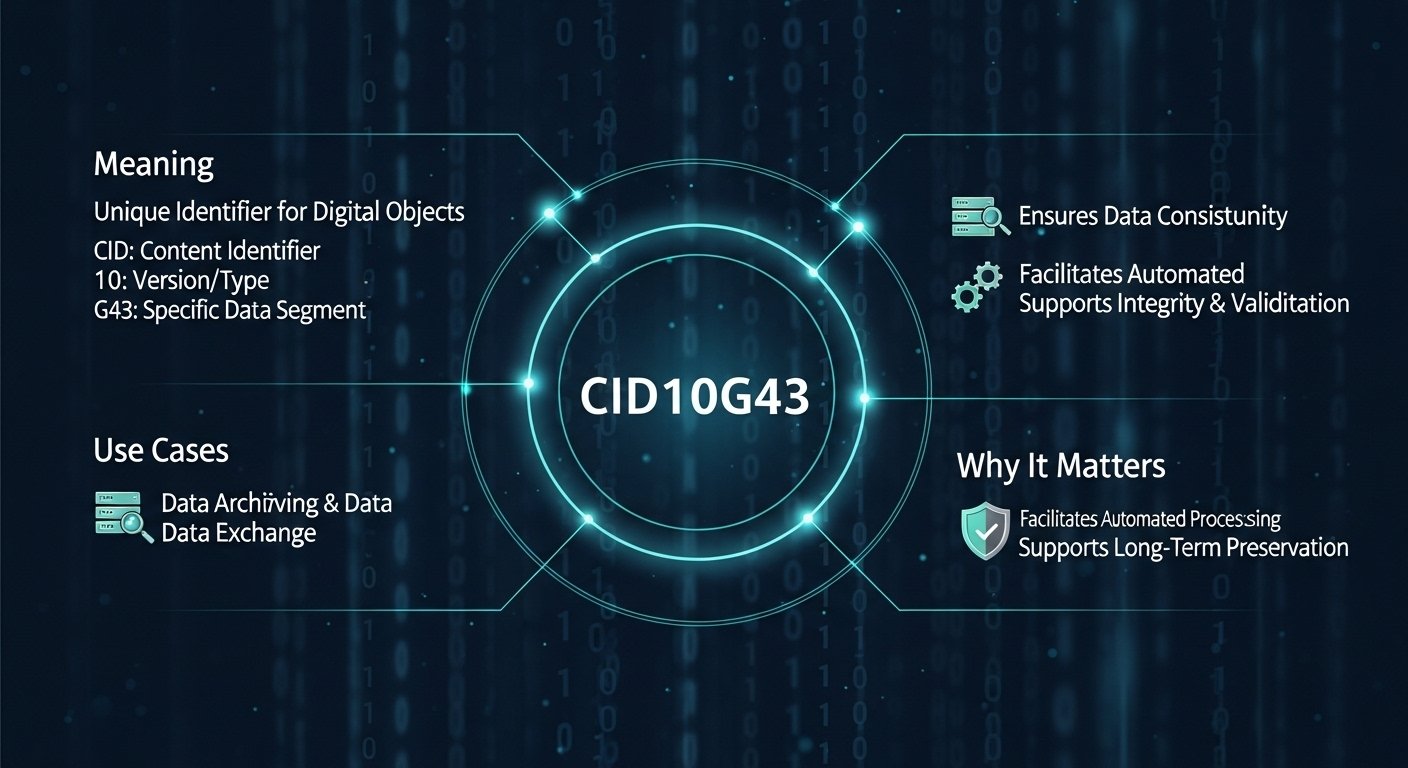
In modern digital environments, identifiers play a silent but critical role in keeping systems organized, secure, and efficient. One such identifier that often raises curiosity is cid10g43. Although it may look like a random string at first glance, it serves specific purposes in structured systems where precision and traceability matter. Understanding how cid10g43 is used, why it exists, and what value it brings can help both technical and non-technical users make better decisions.
What Is cid10g43?
At its core, cid10g43 is a structured identifier used to label, track, or reference a specific entity within a system. These entities may include records, configurations, processes, or internal components that need to be uniquely recognized. Instead of relying on descriptive names, systems often depend on compact identifiers to reduce ambiguity and improve performance.
The value of cid10g43 lies in its uniqueness. It is designed so that it does not clash with other identifiers, allowing systems to locate the correct data instantly. This approach minimizes errors and ensures smooth internal communication between different modules.
Why Systems Use Identifiers Like cid10g43
Modern platforms handle massive volumes of data. Without clear identifiers, managing this data would be inefficient and risky. cid10g43 helps by acting as a stable reference point. Even if surrounding information changes, the identifier remains consistent, ensuring continuity.
Another reason for using cid10g43 is scalability. As systems grow, human-readable labels become harder to manage. Compact identifiers reduce storage overhead and speed up indexing, which is essential for high-performance environments.
Common Use Cases of cid10g43
Internal Data Management
In databases and backend systems, cid10g43 can represent a specific row, object, or configuration. This allows developers and systems to reference that item without confusion. When logs, backups, or audits are performed, the identifier ensures accurate tracking.
Application Configuration and Debugging
During debugging or system monitoring, identifiers like cid10g43 are invaluable. They allow engineers to pinpoint exact components involved in an issue. Instead of scanning through descriptive text, a single identifier can reveal the full history of an event.
Secure Referencing
Security-conscious systems often avoid exposing meaningful names. Using cid10g43 instead of descriptive labels reduces the risk of information leakage. Attackers gain little insight from an abstract identifier, making systems safer by design.
How cid10g43 Improves Efficiency
Efficiency is not just about speed; it is also about clarity. cid10g43 provides both. Systems can process requests faster because they rely on concise identifiers rather than long strings. This also reduces the chance of duplication or misinterpretation.
From a maintenance perspective, cid10g43 simplifies updates. When changes are required, administrators can target the exact element without affecting others. This precision saves time and lowers the risk of accidental errors.
Understanding cid10g43 from a User Perspective
While end users may not interact directly with cid10g43, its presence affects their experience. Faster load times, fewer errors, and consistent behavior often stem from well-managed identifiers working behind the scenes.
For analysts or power users reviewing system outputs, seeing cid10g43 can indicate a reference to a specific internal object. Recognizing this helps in interpreting reports or troubleshooting issues more effectively.
Best Practices for Handling cid10g43
Organizations that use identifiers like cid10g43 should follow clear documentation practices. Even though the identifier itself may not be descriptive, its purpose should be well-defined internally. This ensures that teams can collaborate efficiently without confusion.
Version control is another important aspect. If cid10g43 is associated with evolving data, maintaining a clear history prevents mismatches and data loss. Consistent naming conventions and controlled generation methods further enhance reliability.
Future Relevance of cid10g43
As systems continue to grow in complexity, identifiers such as cid10g43 will become even more important. Automation, artificial intelligence, and distributed platforms all depend on precise referencing. Without robust identifiers, these technologies cannot function at scale.
cid10g43 also aligns well with modern data governance principles. Clear identification supports compliance, auditing, and accountability, which are increasingly critical in regulated environments.
Conclusion
Although cid10g43 may appear simple, it represents a powerful concept in digital system design. By providing unique, stable, and efficient referencing, it supports performance, security, and scalability. Whether used in data management, debugging, or secure configurations, cid10g43 plays a quiet but essential role. Understanding its purpose helps demystify how complex systems stay organized and reliable.